
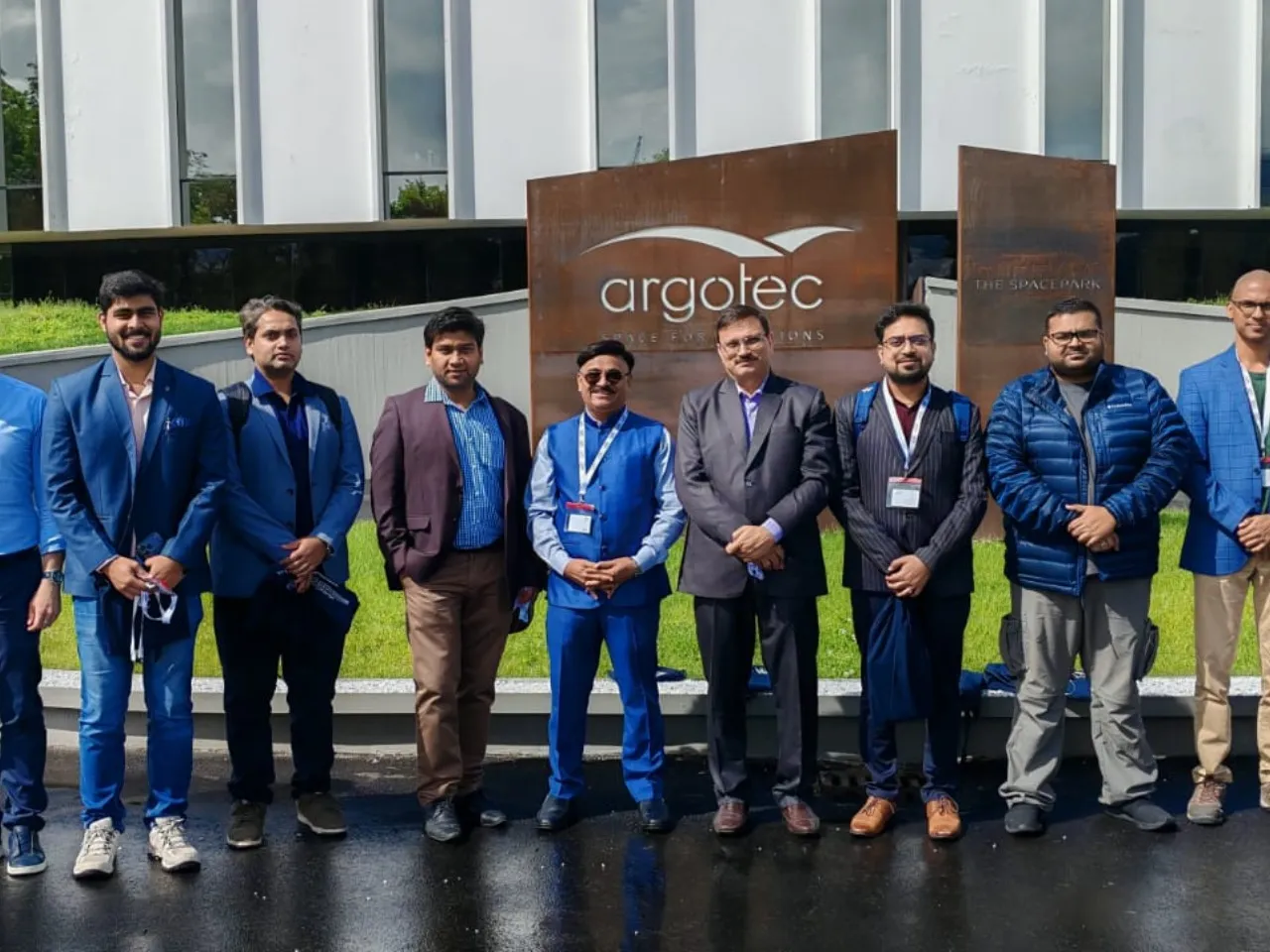
I am sitting in a conference room in Venice, surrounded by aerospace veterans from Telespazio, Thales Alenia Space, JAXA, ESA, and OHB. The morning agenda has just wrapped up. A representative from a major European satellite manufacturer leans across the table and asks me a question with genuine, pointed curiosity:
“So what exactly does an Indian AI company do with Copernicus data that European companies don’t already do?”
It was the most important question I was asked all week. By the time I left Italy five days later, that question had been answered decisively — not just by me, but by the collective presence of nine Indian space-tech startups.
What happened at Space Meetings Veneto 2026 was not a routine trade show. As confirmed by subsequent coverage in the Times of India, The Hindu, and SMEStreet, this delegation marked a highly visible inflection point in India’s global space positioning.
The Weight of the Institution
Walking into a room with European primes as a cold-calling startup is nearly impossible. Walking in as part of a treaty-backed, government-endorsed delegation changes the temperature of the room immediately.
This visit was the product of years of quiet diplomatic groundwork, stemming from the Italy–India Joint Strategic Action Plan 2025–2029. Led by Dr. P.K. Jain and Mr. Brejish Soni of IN-SPACe, and coordinated by the Italian Trade Agency (ITA) and the Italian Space Agency (ASI), we arrived with undeniable institutional weight.
The results spoke for themselves. Landmark agreements were signed on the conference floor, including Astrobase Space Technologies partnering with Impulso Space, and Kepler Aerospace linking with Apogeo Space to expand ground station infrastructure.
As Dr. P.K. Jain accurately noted to the press, these engagements translated into meaningful strategic partnerships, highlighting the global readiness of Indian enterprises.
The Reality Check: Where India Excels and Where We Lag
Five days of back-to-back technical site visits — from Officina Stellare’s precision optics to Argotec’s massive Turin satellite factory — gave me a brutally honest look at the Indian space ecosystem’s standing on the global stage.
The Reality of Our Global Positioning
| 🇮🇳 The Indian Advantage | 🇪🇺 The European Expectation (Our Blind Spot) |
|---|---|
| Government Validation is GoldAn active Indian government work order instantly signals to European primes that your tech is battle-tested, verified, and deployable. | Rigorous IP MaturityEuropean companies secure provisional patents before they even talk to a prospect. Many Indian startups arrive commercially vulnerable without IP protection. |
| Unmatched Operational ScaleOur AI models train on 3.3 million km² of diverse terrain and 100k+ real disaster events — a massive data scale no European country can replicate. | Productization Over Pure TechEuropean buyers don’t care about your ML architecture. They demand operational answers: lead times, false-positive rates, and three-year SLAs. |
The Real Work Behind Closed Doors
We did not fly to Italy just to shake hands. We engaged in intense engineering conversations across the Italian supply chain.
- Zoppas Industries & QASCOM: We witnessed how deep and specialized the Italian space supply chain runs, particularly in GNSS security and precision manufacturing.
- D-Orbit & Leaf Space: We connected with infrastructure players whose edge computing and GSaaS capabilities directly enable platforms like ours to process satellite data efficiently.
- Thales Alenia Space (TAS): For Jarbits, our visit to Turin resulted in a pivotal conversation with the TAS HAPS team, allowing us to submit a proposal for a tripartite collaboration with Cranfield University on GenAI-based HAPS platform design.
The Answer That Changes the Game
Back in that Venice conference room, the European satellite executive was still waiting for my answer.
“What does an Indian AI company do with Copernicus data that European companies don’t already do?”
My answer was simple: We train on real disasters at a scale Europe has never experienced.
I explained that TerraLux’s models haven’t just seen synthetic scenarios. They have processed the 2018 Kerala floods, the 2021 Chamoli rock avalanche, and the 2023 Joshimath subsidence. India has more landslide events in a single year than many European nations have in their recorded histories. We have the validated ground truth that European models simply lack — which is why those models struggle to generalize outside of European terrain.
He nodded, finally understanding the synergy.
This is the future of the India–Europe space partnership. It is not a vendor relationship or a subcontractor arrangement. It is a genuine complementarity, where India’s massive scale and ground-truth data perfectly intersect with Europe’s satellite infrastructure and downstream certification ecosystem.
We aren’t completely there yet. But after Venice, I know exactly what it will take to close the gap.
For partnerships and inquiries: contact@jarbits.com
Sources
- Italian Space Agency (ASI): “The Italian Space Agency hosts an Indian delegation at Space Meetings Veneto”
- SMEStreet: “IN-SPACe Leads Indian Space-Tech Delegation to Italy, Announces Strategic Industry Collaborations”
- The Hindu: “Space Meetings Veneto 2026: Nine Indian space startups sign multiple strategic collaborations in Italy”
- Modern Manufacturing India: “IN-SPACe Leads Indian Space-Tech Delegation to Italy; Startups Sign Strategic MoUs”
- Official IN-SPACe Delegation Catalogue: Indian Space Industry Delegation to Veneto Space Meetings, 2026 (PDF)